Are AI Detectors Accurate? How to Read the Evidence
TL;DR
AI detector accuracy depends on the writing, the threshold and the test. Even a high overall accuracy can leave a reviewer with a stack of false alarms.
- Count the human essays that got flagged.
- Check how many generated essays slipped through.
- Ask whether the test material resembles the writing on your desk.
How can a detector be accurate and still flag human writing?
For this experiment all you need is paper. The numbers are made up. There are a hundred essays on the desk, fifty written by people and fifty by a language model. You have the answer key.
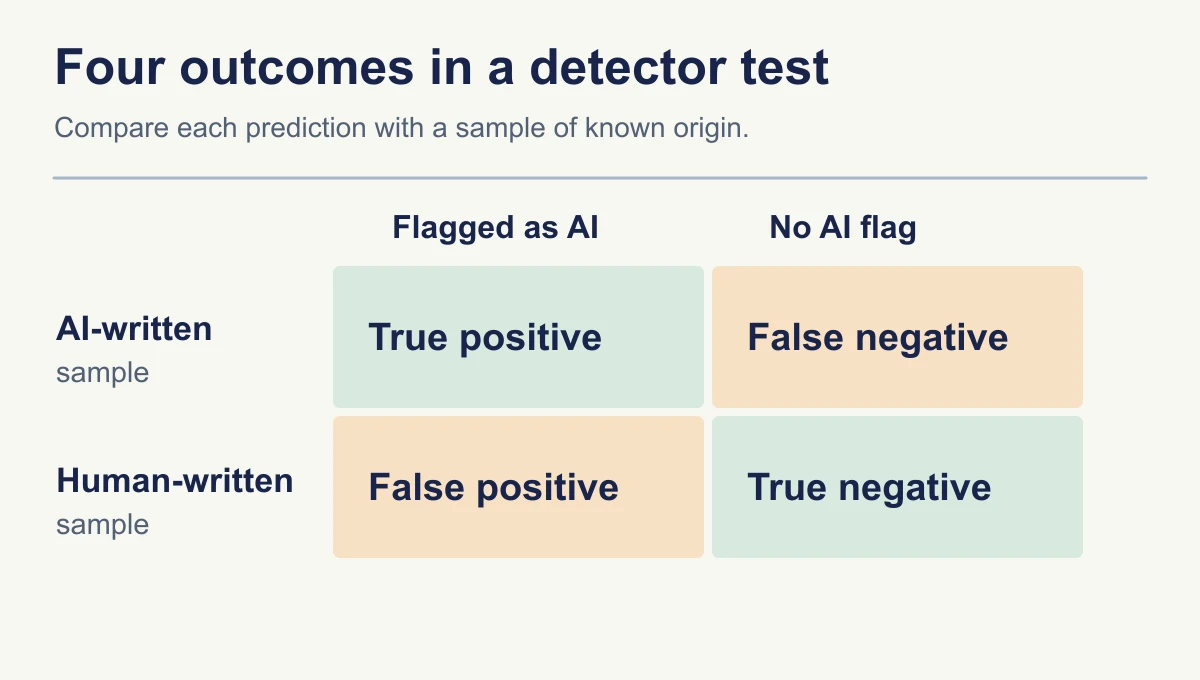
On the machine side of the desk the checker has flagged forty of the fifty. Ten got past it. Over on the human side it has left forty-five pieces alone and flagged five by mistake.
Put a finger on those five. If you were one of the students who'd written them, that would be the part of the result you'd want to hear about first.
| Who wrote the essay? | AI flag | No AI flag |
|---|---|---|
| Human (50 essays) | 5 false alarms | 45 correct |
| Language model (50 essays) | 40 correct | 10 misses |
Try it on your own text
Paste your text and see the AI detection result right here. You can keep reading below.
Which denominator belongs under each count?
Forty right on one side, forty-five right on the other. That's 85 right out of 100, or 85 percent accuracy. Five of the fifty human writers got a false alarm, which makes the false positive rate 10 percent.
How many of the generated essays did it catch? Forty out of fifty, or 80 percent. That's its recall for generated writing. A teacher holding the stack of flagged essays has a different denominator again. There are forty genuine hits among the forty-five papers on the teacher's desk.
What happens in a class with fewer generated essays?
Make it a hundred essays again. This time say only ten came from a generator. Leave the detector alone. Give it the very same chance of catching a generated essay and the very same chance of wrongly flagging a human one.
Work on the short pile first. Eight of the ten generated essays should get picked up, on average. Now for the ninety human essays. One in ten means another nine names on the list.
That's seventeen flags for the teacher to look at, of which nine concern human writers. Nobody touched a dial on the checker. All we changed was the mixture of work it received. The actual mix for a real class is usually the very thing the teacher doesn't know.
Where did the test essays come from?
You might want the tool for little biographies on the back of a book jacket. Or for translated messages that come in to a help desk. If the test involved long, unedited news articles, look for a closer match.
Also check what got graded. A tool might get the label on a whole essay right and underline a sentence that the student actually wrote. If you plan to query individual sentences, look for an evaluation of the underlining.
The RAID researchers tested detectors across different generators and domains. Liang and colleagues looked at a different question. Among the English samples they tested, several tools wrongly flagged human writing by people who learned English as another language. For a class like that, you'd want to see the results for those writers.
consistently misclassify non-native English writing samples as AI-generated
Where was the cutoff?
Think of a clerk drawing a line through a long list of scores. Anything above the line goes to a reader for review. Moving the line down a little makes the clerk hand over more papers.
Some will be generated essays the previous setting missed. Some may belong to students who wrote every word. When comparing two detectors, find the setting each used and the counts of human papers each setting sent for review.
How to run a small accuracy test
For a publisher, the writing you'd like to check might be the English summaries your own editors have just written for an exercise. Ask permission to use them, then save the copies you plan to check.
- Make the answer key first. Write down who produced each piece while the drafts and the writers are still to hand. Put work written jointly with a model in its own group. Decide in advance what you want to learn from it.
- Use the same material. Give each service exactly the same pieces. Record the language, length, date and settings. Mark the pieces a service refused and why, if it says.
- Keep the tally marks. Two human pieces flagged out of ten and twenty out of a hundred both come to 20 percent. Keep the counts of both sorts of error so a reader can see what went into the percentage.
What about the essay in front of me?
A flag brings you back to a particular writer. Ask to see the passage, an earlier version and the source of the claim somebody is questioning. That's where the investigation leaves the stack of benchmark essays and starts to look like a conversation about the work.