Can AI Detectors Detect Paraphrased or Edited Text?
TL;DR
It can, though the edited notice in our experiment came back ‘human’. An AI assistant had written every last word of it.
- Read the original and the rewrite below.
- Look at both the label and the AI share. Each notice got a zero for the share.
- A reader with both drafts can see which sentence the editor changed.
Would you guess who wrote this notice?
The map room will be open to visitors on Saturday morning. On arrival, please leave wet coats on the hooks by the door. A member of staff will bring the requested maps to the large table in the center of the room. Pencils and sheets of paper will be available for anyone wishing to take notes. Before leaving, please return the pencils to the blue cup on the table.
That was the whole of our first submission. If you're going to have a guess at its authorship, have it now, before you read the other notice.
What took your fancy? The slightly officious bit about a member of staff, perhaps? Somebody remembers to put out paper but expects the visitor to have brought a wet coat. It sounds plausible enough for a Saturday in November.
Try it on your own text
Paste your text and see the AI detection result right here. You can keep reading below.
After the rewrite: same room, same blue cup
Visiting the map room on Saturday morning? Hang your wet coat on a hook by the door, then head for the big table in the middle. A staff member will bring over the maps you asked for. There are pencils and paper for notes. When you're done, pop the pencils back in the blue cup on the table.
See where the table went? In the first notice the staff member brought the maps to it. In the second the visitor goes there first, and the staff member brings the maps over afterwards. All the visitor really needs to remember on the way out is the blue cup. The little world inside the notice is much the same.
You have just read two pieces written for this experiment by an AI assistant. It made the first one up, then rewrote it. Nobody stood outside an actual map room with a clipboard.
We saved both copies before we opened the checker. That last detail matters. If we'd kept rewriting until a particularly interesting pair of results turned up, there would be a rather different story to tell.
What came back from the map-room check?
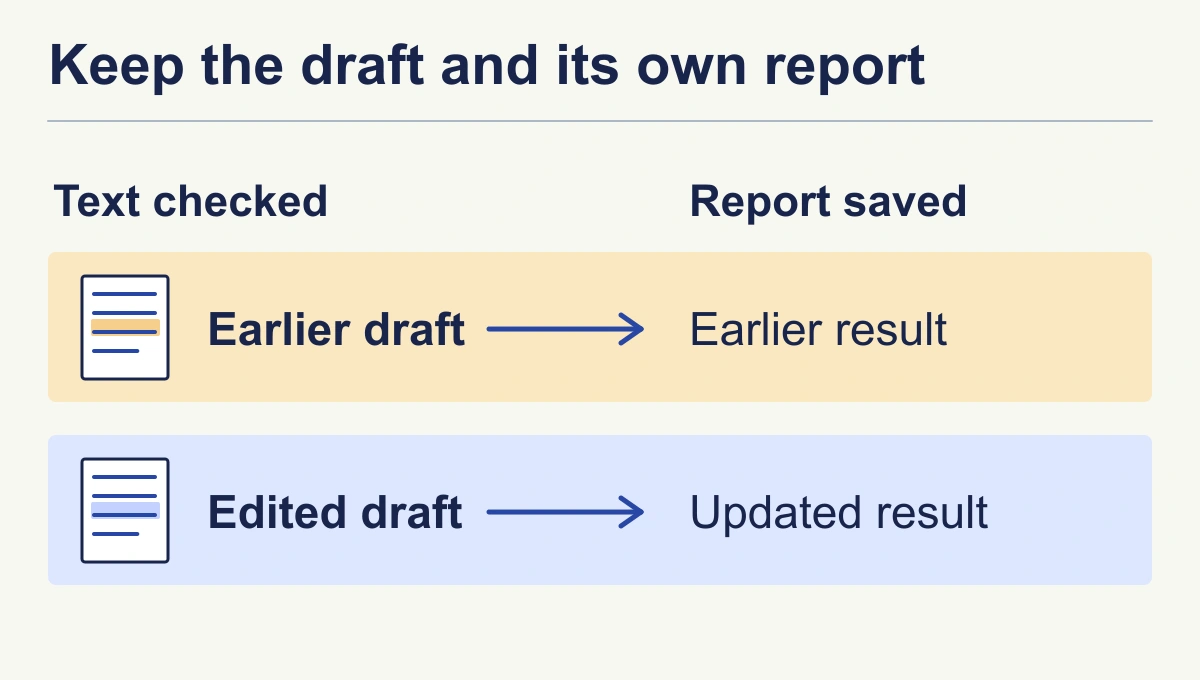
Read down the left side of the results sheet. First the longer notice. Below it, the one where the visitor goes straight to the big table. Both went through the same Its AI service on November 20, 2026, local time.
Now run a finger across from ‘Rewrite.’ Has ‘human’ identified a human editor at work? There wasn't one. Is the zero a count of the words the machine supplied? We can answer that one too. We kept the drafts.
Here’s a small trap in the last two columns. Suppose all you’d kept was the zero on each sheet. You might have told a colleague that the checker returned exactly the same result twice. Have another look at the labels before you make that phone call.
| Notice | Words | API score, rounded | Verdict | Estimated AI share |
|---|---|---|---|---|
| Original | 69 | 0.2571 | likely-human | 0% |
| Rewrite | 58 | 0.0318 | human | 0% |
How to repeat the map-room check
We kept a public record because it’s surprisingly easy to make a muddle of two near-identical notices. ‘The map room one’ could mean either sheet. Here is what you need to repeat our check.
- Copy the original notice. Take the first input from the public record under Sources. Copy every word from ‘The map room’ to ‘on the table.’ The title belongs on the web page. It wasn't on the piece of paper the checker saw.
- Send the rewrite separately. Now fetch the notice that starts ‘Visiting the map room’. Using your own access to the Its AI v2 text endpoint, send a request with just this notice in the text field. We did the same with the first notice and left every setting at its default.
- Keep the actual replies. Write down both labels. In the margin put the AI share, the separate score and the time the reply arrived. We’ve kept the unrounded figures in the record. If you try again later you may have caught the service at a different version.
What can a paraphrase check tell you?
Cover the first notice with your hand. If that was all your teacher or editor had, could they tell that the table once belonged to the sentence about the staff member? They might form an opinion about the style. They'd have a job reconstructing the other sentence, though. You knew where to put your finger because we gave you both copies.
For its English report Turnitin says it can flag qualifying AI writing that has also gone through an AI paraphraser. Quite a specific claim. Our two little notices went through Its AI. You wouldn't learn much about Turnitin by counting the misses in our table.
it may misidentify human-written, AI-generated, and AI-paraphrased text
How much work went into the rewrite?
Try it the other way round. Somebody at the map room has been handed a printed notice and a rather small card to stick it on. They take out a sentence to make the thing fit. Suppose a chatbot, faced with the same shortage of space, takes out the very same sentence. There are two identical cards on the desk. How long did the person spend editing theirs? You won’t find a little time sheet in the API response.
As a test of accuracy, a pair of short English notices is thin gruel. You'd need examples from more than one source, including human writing and known human edits, before you'd have a basis for comparing errors. Look at the RAID benchmark for an idea of the range of texts a detector can meet.
For your own work it’s the actual pair that’s valuable. Keep what you started with, keep what you handed in, and jot down why that table moved. That’s one small piece of editing you really can demonstrate.