Why Is My Writing Flagged as AI When I Wrote It Myself?
TL;DR
You can write every line yourself and still get an AI flag. A detector reads the finished wording and can guess wrong about its origin. Start by finding out exactly which part of your work went into the box.
- Ask to see the text as well as the score.
- Find where the assignment question ends and your answer starts.
- Keep the draft or notebook page that explains the disputed line.
Whose words were in the box?
Imagine you're getting your lab notebook out for another class when the message comes in. Your report has come up as AI. You know perfectly well where you were yesterday afternoon. Half the class saw you at the bench. So what, exactly, has the software checked?
With a screenshot alone, it's hard to tell. Was the selection the whole sheet? Just your conclusion? The instructions and a paragraph from the manual may be right above your account of the experiment. The color of the bar doesn’t tell you where the person doing the checking let go of the mouse.
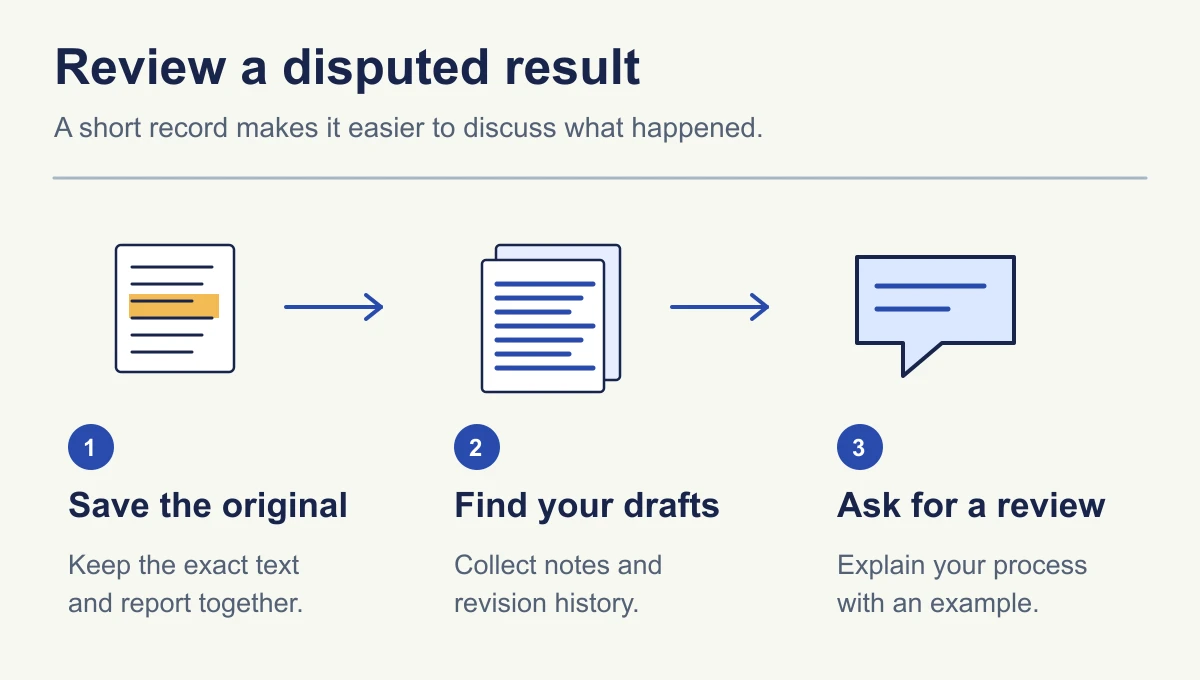
A useful first reply is a short one. “Could you send me the text you pasted in, and the report that came back?” Put them next to the file you actually handed in. Yesterday's working draft may differ from the paper attached to the submission receipt.
Try it on your own text
Paste your text and see the AI detection result right here. You can keep reading below.
Can a whole class write the same sentence?
Think of twenty students who all kept their samples at room temperature for ten minutes. What should they put in the report? “The samples were kept at room temperature for ten minutes” would do nicely.
That sentence is an illustration. We haven't tested it in a scanner. But it doesn't leave each person much room to distinguish their prose from everybody else's. A language model could also come up with it quite easily.
The detector has no record of who set the timer or wrote up the method on the way home. When a human passage gets the machine label, the term for the mistake is a false positive.
Do false positives affect everyone equally?
In 2023 Liang and colleagues tried several detectors on English writing samples from native and non-native writers. They found that the tools frequently mistook non-native writers' work in their sample for machine-generated writing.
If you're looking at a result on a single lab report, the study gives you a question for the reviewer. Has this particular tool been evaluated on writing like yours? The researchers didn't see the report on your desk, and their results can't diagnose what happened to it.
these detectors consistently misclassify non-native English writing samples as AI-generated
What happened when the text was copied from the PDF?
Try copying two columns out of a PDF and pasting them into an empty note. Sometimes the first sentence on the left marches straight into the first sentence on the right. Find the last word of the assignment question and the first word of your answer. Did the checker get both?
| In the text the checker saw | A question for the person who submitted it |
|---|---|
| “Write your observations here” above the conclusion | How much of this sheet was supplied to everybody on Monday? |
| Half a sentence about salt followed by half a sentence about the control | Can we open the PDF and follow each column down the page? |
| Two lines from a whole page of discussion | Did you select those two on purpose? Free AI Detector suggests using a few paragraphs when you have them. |
What do I bring to the meeting?
Here's the bit of the meeting I'd want to get to. Your conclusion says the conductivity went up. The reviewer has drawn a line under “conductivity.” Open the page in your notebook with the salt solution on the left and the control on the right. Which readings went into that sentence?
There might be an ordinary mistake waiting for you there. Perhaps it was the control that went up. That's an actual reason to amend the paper. Looking for a more unusual synonym for the quantity you measured seems a peculiar way of clearing anything up.
- Find the copy you handed in. Take the paper attached to the submission receipt. The draft you were still working on after dinner might already have a change of wording.
- Open the notebook at the right page. Put a slip of paper beside the readings you used. When you're asked why the paragraph says the value went up, you can show the reviewer where you saw it happen.
- Tell the reviewer who helped with what. Did somebody suggest a word? Did a translation tool help with the instructions? If there was help, say what it was and look up the rule for that assignment together.
What could I put in an email?
“Was it the conductivity paragraph that raised the question? I still have the readings and the draft with my first explanation. Would you like the two files, or shall I bring the notebook to class?”
Use the particulars of your own report. You might have a sketch of the apparatus and a scribbled correction to the temperature reading. Great. Take the sketch. The fact that you can explain why you crossed out that number tells the reader something about the work that was done at the bench.