How Do AI Detectors Work? A Plain-English Guide
TL;DR
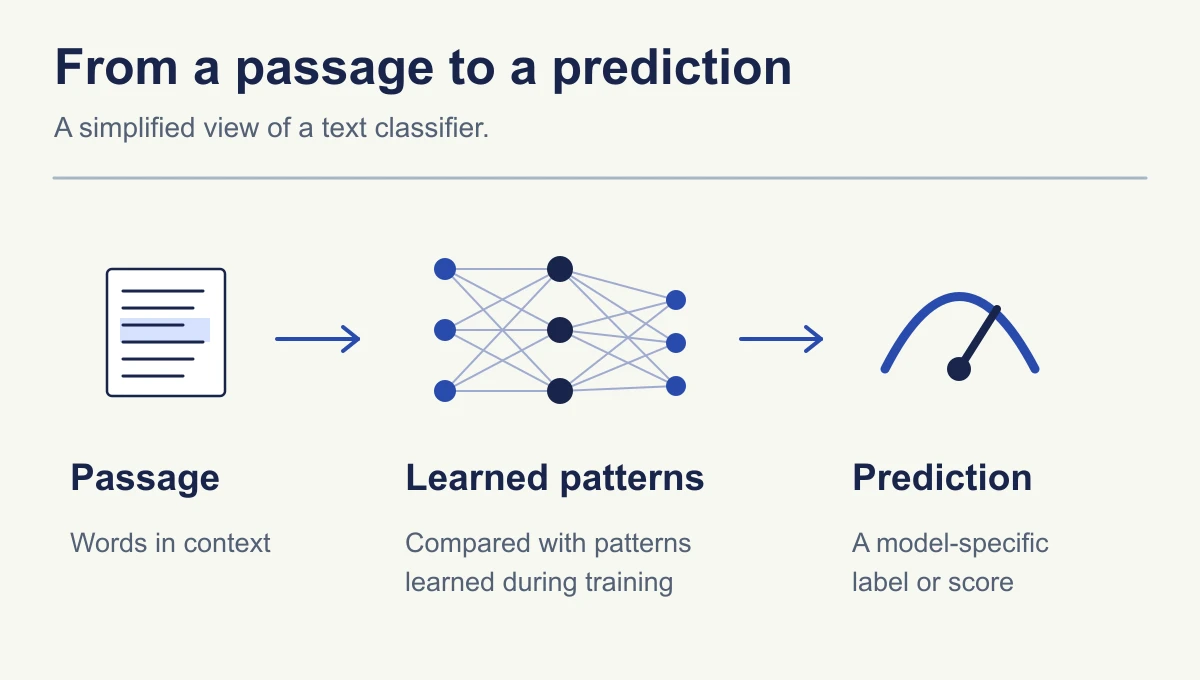
An AI detector reads a passage and estimates whether its wording resembles generated writing. Some learn from labeled examples. Others use a language model to score the words in context.
- The checker sees the words you submit.
- Predictable wording can come from any writer.
- Where a developer sets the cutoff affects which passages get flagged.

What does the detector see?
“The west entrance will close at six.” Suppose somebody asks a text detector who wrote the notice. Here's what the software gets to work with. Seven words and a full stop.
The receptionist might have typed them. She might have taken them from last winter's notice, translated them, or asked a chatbot to write a line that would fit on the door. The sentence reaching the software in each case could be identical.
Give it the whole letter about the closure and it can examine the sentences around the notice, too. Evidence of a rather different sort might still be sitting in the receptionist's notebook. There, in yesterday's list of jobs, is the time the night porter told her to put on the door.
Try it on your own text
Paste your text and see the AI detection result right here. You can keep reading below.
How can a classifier learn from examples?
Suppose you have two drawers of writing with the origins marked on the back. There are restaurant reviews from real diners in the first drawer and business letters from a generator in the second. You give a classifier examples from both drawers.
In training, the system adjusts the weight it gives to patterns in the wording as it learns to tell your two collections apart. You've also put some samples aside. Those go into a separate test, once training is over.
Now listen to the first line of a real letter from a customer to city hall. “Dear Sir or Madam.” In your drawers that greeting was a pretty good clue to the answer. What does it tell you about this customer?
| Training examples | A clue with two explanations |
|---|---|
| Human restaurant reviews | “The soup was cold” can give away the subject of a review. |
| Generated business letters | “Dear Sir or Madam” might identify a letter, whoever wrote it. |
What are perplexity and burstiness?
“Please take a seat” is a fairly predictable invitation. “Please take a sundial” sounds a little more startling. Unless, of course, you happen to be in the workshop where the class has just finished making sundials.
Perplexity measures how surprising a sequence of words is to a particular language model. Include the workshop conversation, and the estimate can change.
Burstiness is a looser term in discussions of writing. It can refer to variation in sentence length or rhythm across a passage. Read a recipe aloud. Plenty of cooks use the same construction several times in a row because the instructions are easier to follow that way.
Does every AI detector need a set of labeled essays?
The DetectGPT researchers worked with a passage and small variations in its wording. Another language model helped make those variations. The researchers compared how the model they were investigating scored the original and the alternatives.
For some generated passages, the original sat in a spot where changes tended to bring the score down. That pattern helped the researchers distinguish generated writing. They could do the comparison without first having a classifier learn the difference between the two drawers of examples.
The experiment does need access to the model's probabilities. A website can tell you its method in the documentation. A percentage on its front page gives you little to go on.
does not require training a separate classifier
What turns the model's estimate into a flag?
Imagine a clerk sorting passages by their scores and putting a paper clip at the first one that needs review. Move the clip along by a few places. A whole handful of passages has now changed status, although nobody's touched a word on the page.
The clip stands for the decision threshold. Where it goes affects how often a tool raises a false alarm or misses generated text. Performance can change with the material, too. The RAID researchers tested detectors across different generators and subject areas.
How to make sense of a result you can check
For an exercise, find a passage you have permission to use and whose history you know. Read what the tool says about that passage.
- Keep the submitted copy. Which part did you give the checker? Our seven-word notice and the entire letter are different inputs. Record any message saying the sample is too short.
- Find the definition of the score. Does the tool label the whole letter or mark particular sentences? Save the words that sit beside the number.
- Look outside the report. If the question is who set the closing time, the porter's message might settle it in a minute. Testing how often a detector is right takes a collection of known examples and a count of its mistakes.