Why Do AI Detectors Give Different Results?
TL;DR
The checkers may have read different passages. Even with the same text, each uses its own model, threshold for a flag and scoring scale.
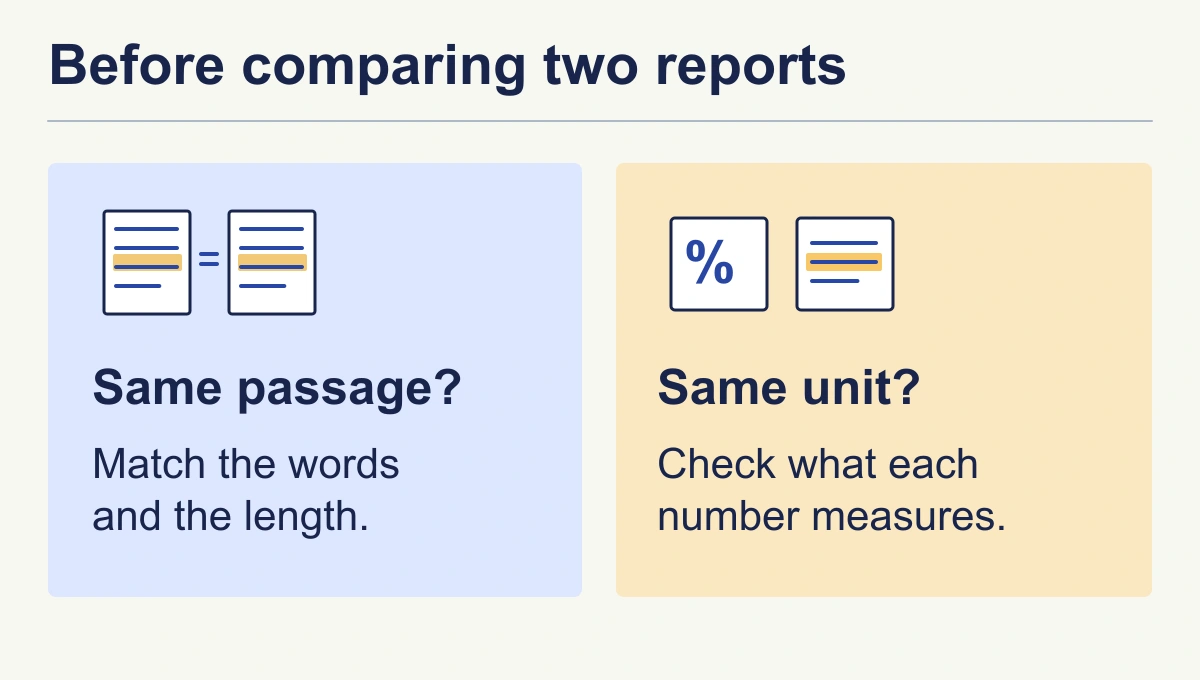
- Match the two passages, down to the last line.
- Check what the number on each report measures.
- For an authorship dispute, bring the draft.
Did both detectors read the same essay?
Imagine a history teacher holding two printouts about the same essay. One has a big percentage at the top. The other says the writing looks human. The student wants to know which report the teacher believes. Before picking one, turn the pages over. Where does the writing on each one end?
In this example the first copy ends halfway through a quotation. The other runs all the way through the student's account of how she found the letter she quoted.
Someone checked a selection in one service. Someone else uploaded a file to the other. Both printouts carry the same essay title.
Try it on your own text
Paste your text and see the AI detection result right here. You can keep reading below.
What does each percentage measure?
There's a question you can ask even before you see the number. What's the dial on this particular machine supposed to tell me?
Picture a school lab report. Columns of figures take up a whole page. The part about the cracked slide that spoiled a reading runs to a few lines on the next page. When Turnitin says ‘qualifying text’, think of those few lines.
| Report | What the percentage describes |
|---|---|
| GPTZero | Confidence in the classification it gives the submitted text as a whole. |
| Turnitin AI Writing Report | The share of qualifying prose that its model flags as likely AI-generated or AI-altered. |
A GPTZero result has two parts: a class and a confidence.
Why can't I average the two scores?
Now for a little arithmetic that doesn't work. On a slip of paper put “80% confident about this document.” Underneath, put “20% of eligible prose flagged.” These are made-up numbers, which makes it tempting to play with them.
Add the numbers and divide by two and you get 50. But what would you write after the 50? Half a document? Half a chance? The calculation has thrown away the very information that made either figure intelligible.
Can detectors disagree even when the words match?
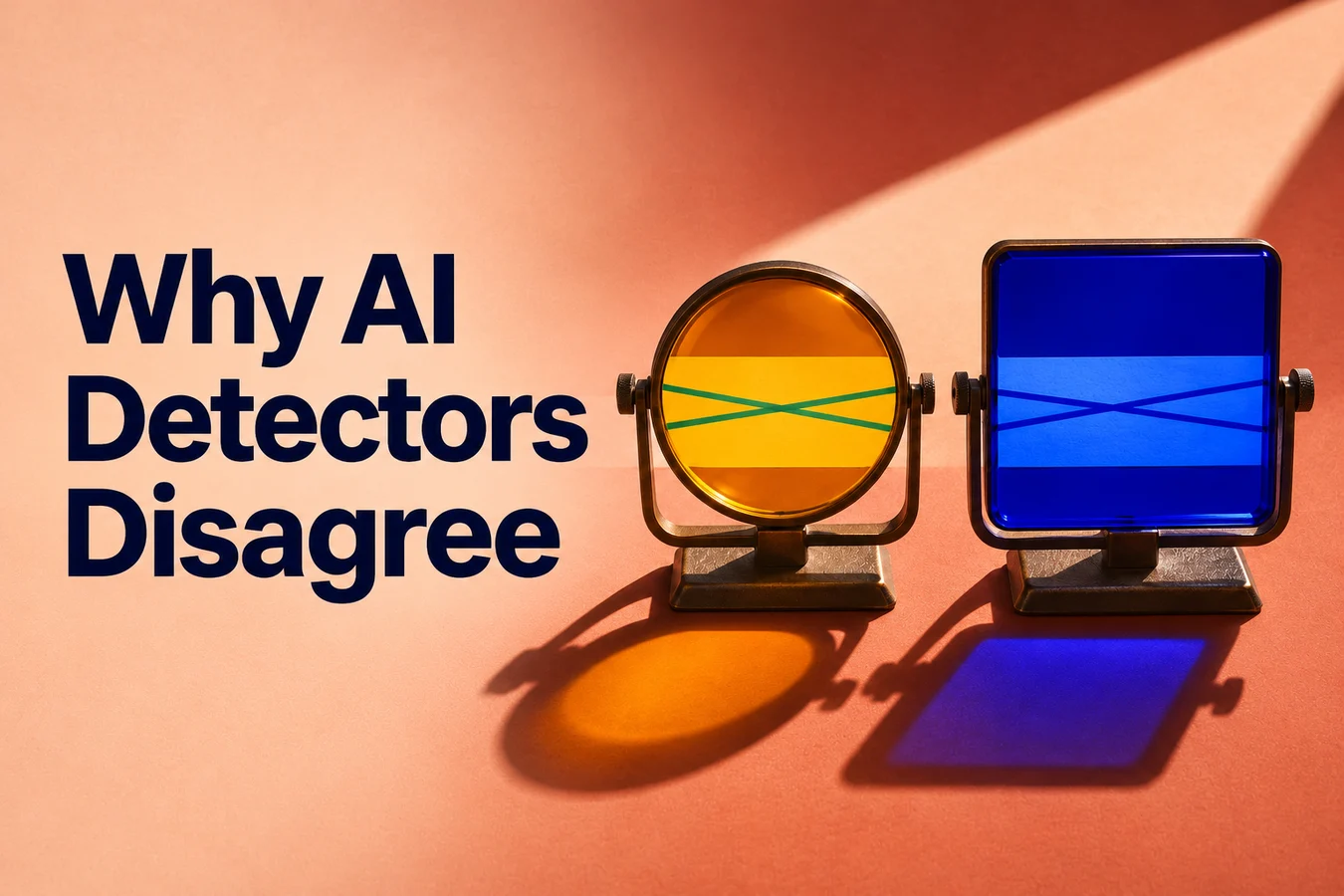
Suppose you've checked the copies and all the words match. That's a useful finding. It rules out the missing quotation. It doesn't oblige two models to agree.
A developer building a detector chooses examples of human and generated writing, a method for distinguishing them and a point at which to show a flag. A different developer can make different choices about every one of those things.
Think about a pile of letters sitting just on the borderline. Lower the threshold a little and some letters will go into the review tray. Raise it and some come back out. Nothing happened to the letters themselves.
The RAID team put detectors through their paces on writing from different generators and subject areas. How they did depended on what was in the test. Fair enough to ask, ‘Did they try this on letters?’ Quite a leap to say you know what made a checker flag the one that's on your desk.
How to compare two conflicting reports
Suppose a colleague who missed the meeting inherits the file on Monday. Here's what I'd like them to find when they open it.
- The two texts. On the first printout: ‘Teacher's selection from the English essay, ends at “we sailed”. Copied from the PDF.’ On the second: ‘Whole file uploaded.’ Now your colleague can turn straight to the quotation and see where the first copy stopped.
- The two labels. Say the slip of paper reads ‘80’. Eighty what? I'd want the checker's name and the words that sat right beside that number. Add the date and any mode or version the screen gave you. Staple the slip to the printout.
- One clean copy for a repeat check. Take a passage you have permission to use and give both checkers that copy on the same day. Keep any message about minimum length. An empty space on the second printout might mean the input was too short. There isn't a human verdict hiding in that space.
What evidence would settle the question?
The student's notebook might have the best question in the whole file. There, beside a sketch of the postmark, imagine finding something like “Is that a 3 or an 8?” On the next page she's looked up the sailing date and changed her mind.
Suddenly there's an actual piece of the essay to talk about. Ask her where she found the date and what made her change the paragraph. If there's a concern about the quotation, leave the rest of the paper on the table and look at the quotation together.
None of that depended on casting a deciding vote with a third checker. A test of a tool calls for writing whose origin you know. A conversation about a student's essay calls for the student's evidence. In this case the person who can explain the little number on the postmark is sitting across the desk.
False positives (incorrectly flagging human-written text as AI-generated) are a possibility in AI models.