What Percentage of AI Is Acceptable in an Essay?
TL;DR
There's no universal acceptable AI percentage for an essay. The assignment tells you what help you can use. A detector reading can't grant permission or establish what you did.
- Check the brief for the particular essay.
- Ask about the specific help you have in mind before uploading your work.
- Describe what you used and kept, in the form the course asks for.
Who sets the rules for an essay?
Suppose you have a film essay due on Friday. In the seminar somebody asked whether it was all right to get help with an outline. Your lecturer said yes, provided you kept the prompts and submitted a short account of what you did.
Across the hall your friend has a different assignment. Her instructor wants to see the student's own first attempt at an outline. She can bring her rough outline to office hours for feedback.
These are imaginary courses. But you might both write good essays, get the very same percentage on a checker and still have quite different obligations to your instructors.
University College London gives a real example. Its guidance directs students to the instructions for the specific assessment and to the module leader when there's a doubt about what the instructions mean.
What is appropriate for one assessment may not be for another.
Try it on your own text
Paste your text and see the AI detection result right here. You can keep reading below.
Which percentage is the course talking about?
Imagine writing “8 percent, according to my checker” in the little box marked “How did you use generative AI?” There's a fairly obvious follow-up question. Did you use any at all?
You might have gone straight from your own notes to your own essay. Perhaps a chatbot gave you a suggested order for the scenes and you worked from that. The person reading the box would have no way to tell.
| What you're reading | What the number refers to |
|---|---|
| An assignment limit | The share the instructor permits, using the definition in that brief. |
| Turnitin AI Writing Report | The share of qualifying prose the model thinks may have been generated by AI. |
| Turnitin Similarity Report | How much of the submission matches material in its sources. Quoted dialogue can match. |
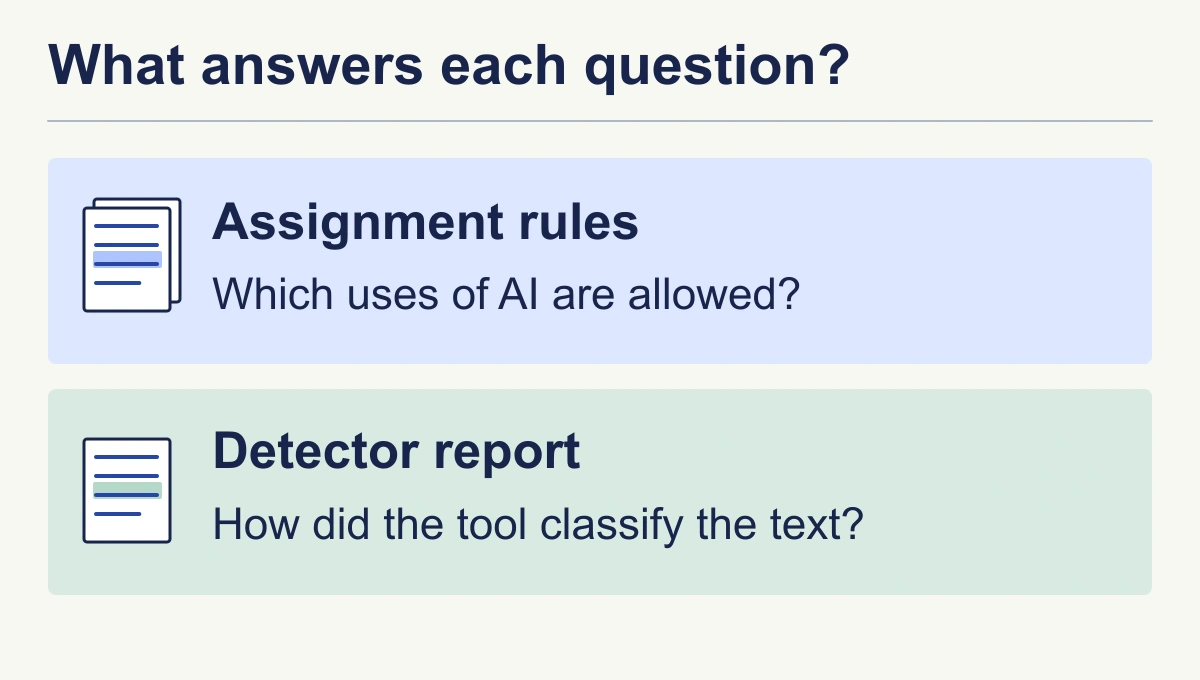
What if the rubric really does give a limit?
Take the sentence containing the figure and read the sentence after it as well. “Up to a tenth of the submitted text” would immediately make me wonder about words copied over from a prompt, or a generated sentence that was rewritten from scratch. Does either count?
On a course where this matters, ask while you still have both versions. The definition in those course notes is the one you need. A web search for an acceptable percentage can turn up perfectly good answers to somebody else's assignment.
How do I ask about using a chatbot on my outline?
“I have a page about the cut from the station to the empty house. I can't decide whether it belongs before or after the paragraph about sound. Could I show just the outline to a chatbot and ask which order makes more sense?”
You could send that in an email. The seminar leader can see how much of your work would go into the chatbot. They can also tell you if you're about to give away the part of the exercise they've been hoping you'll do for yourself.
- Find the directions for this submission. The outline might appear only in the small print under material to attach. Treat it as part of the assessment if the lecturer is going to mark it.
- Ask what you can share. Mention which material would go into the tool, which tool you have in mind and what you want it to do. Keep the reply with the assignment.
- Keep a copy of Friday's outline. What seems perfectly obvious on the evening you did the work can turn into an exasperating half-hour spent hunting for a file. Download it while it's open.
What did you keep of the chatbot's reply?
Here's one possible note from our imaginary film student. “I wrote the descriptions of the station and the house. I asked a chatbot whether the paragraph on sound would work better earlier in the essay. It suggested moving it up. I left it where it was. I've attached the question and reply.”
Maybe the instructor wants the tool's name and the date as well. Anyone who kept a generated paragraph would need to write a different note. Look at the instructions for the declaration itself.
Suppose instead that the tool proposed an interpretation you hadn't thought of. You kept the idea and expressed it in your own words. Would that change your note? It ought to. A declaration about where the idea came from is a different matter from counting how many of the tool's words made it onto the page.
I wrote the essay. What if the score is high?
It happens that a checker flags words somebody actually wrote. Ask which passage concerned the lecturer. You might learn that what they're after is the missing disclosure on the last page. That's a much easier conversation to have once you both know it.
At office hours the marked-up script could be more interesting than the score. Perhaps you crossed out a note about music when you went back and listened to the scene with headphones. Bring the earlier version and explain what you heard.
Or take the same scene the other way round. Suppose you pasted in a generated account of the train pulling out of the station, against an instruction to describe it for yourself. The checker waves it through. You still owe the reader your own look at what happens on screen.