AI Detection vs. Plagiarism Detection: What Each Check Can Tell You
TL;DR
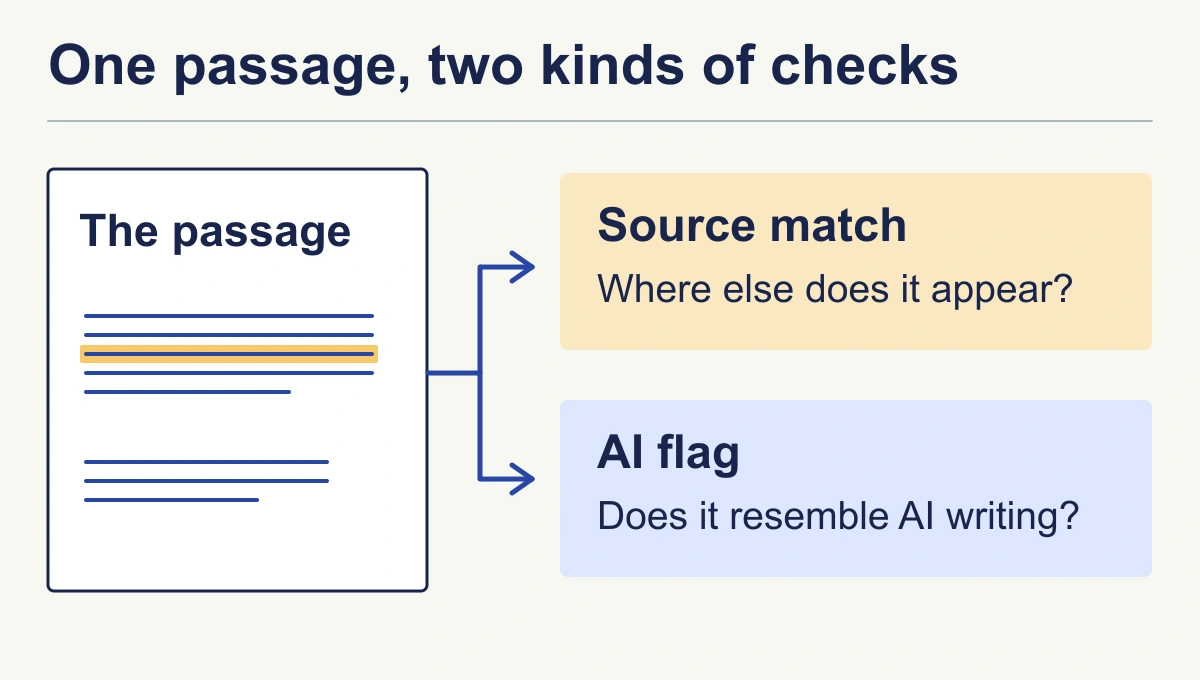
If a similarity checker flags the line under a museum photograph, you can ask to see the source it matched. An AI detector offers an estimate of how the line was written. Either report still leaves the editor some reading to do.
- For a match, put the original wording alongside the caption.
- Look for quotation marks and a credit right where the words appear.
- Ask for the contributor's notes if what you want to understand is the drafting.
A worrying screenshot arrives at the museum
The printer wants the catalogue by Friday. The caption under a photograph of the old fog bell is holding everything up. It reads, “The fog bell rang twice for the outgoing boat.” In this imaginary museum the editor has just received a screenshot about that sentence. Is the name of the checker visible anywhere?
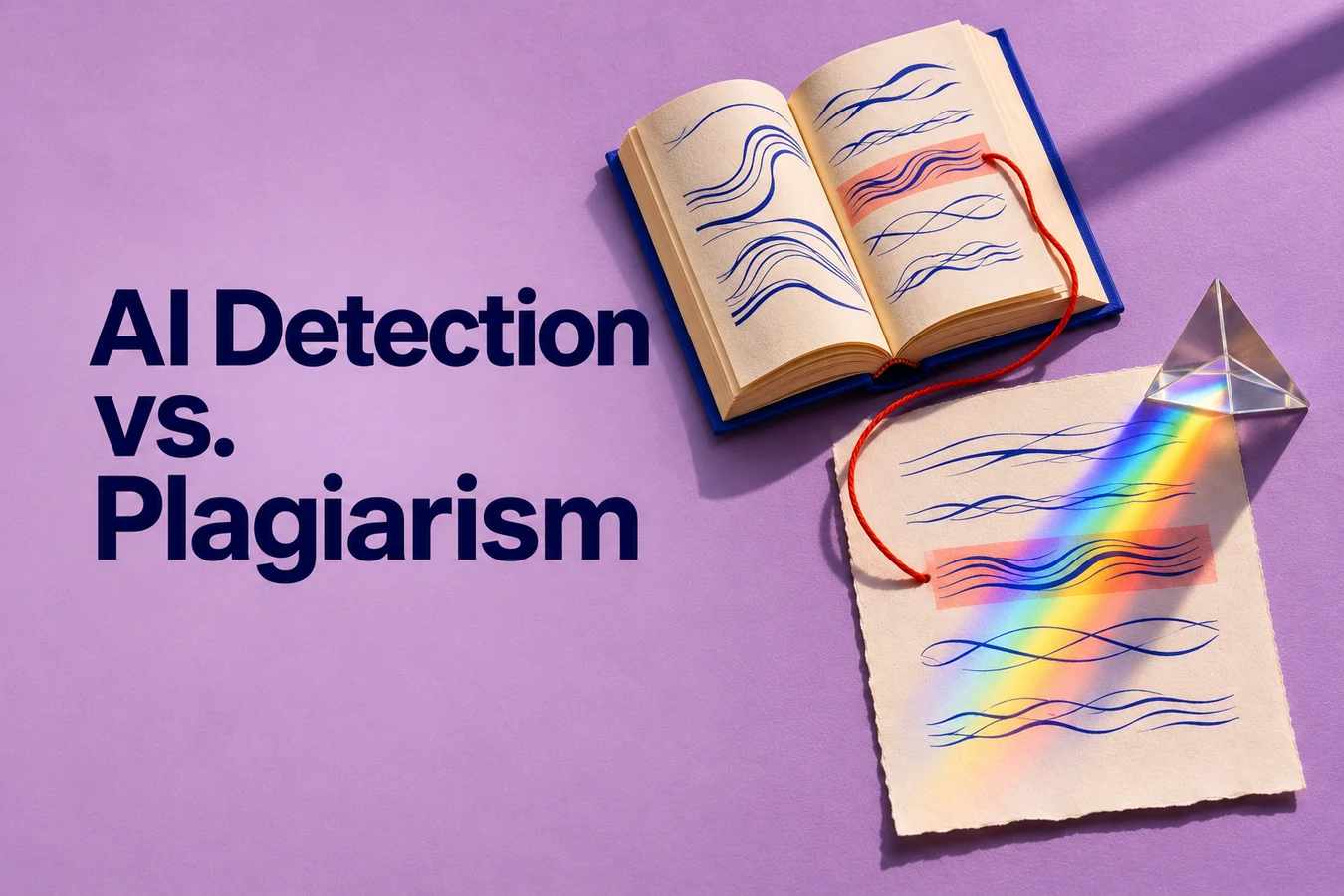
Maybe there's a link on the screen to an old harbour guide. Go on, open it. There's the bell on page six. Does the printed line actually say “the outgoing boat”? Whose name's on the cover? If it's a match, the editor has a place to start and something to lay on the table beside the photograph.
Or maybe the screenshot just says the line looks like AI. No harbour guide, then. No author of a matching sentence to telephone. If the editor wants to find out how the contributor wrote the caption, it's their notes about the bell that are worth asking for.
Try it on your own text
Paste your text and see the AI detection result right here. You can keep reading below.
Why would a properly quoted sentence show up?
Have a look at the punctuation on the little card that goes with the bell. A pair of quotation marks round the line, an author's name, the edition and page. Would it be a problem if someone found that sentence in the old guide? You'd rather hope they would.
Turnitin's Similarity Report can highlight a quotation even when you've supplied a reference. Its AI Writing Report measures something else. Subtracting one percentage from the other won't tell you what share a student wrote.
But look again at the catalogue. Suppose the contributor listed the guide at the back and left off the quotation marks up front. How is a visitor meant to tell which words came off page six? That's a job for the editor, however small the overlap.
Could the same caption involve both AI use and plagiarism?
Turn the picture of the bell over. On the back there's room for a note about how the caption was written. Here are four made-up histories for our line about the outgoing boat. Nobody ran the examples through a scanner.
| Suppose the contributor says … | What would you check? |
|---|---|
| “I talked to the retired boatman. That's my summary.” | Get the date of the interview. Did he say twice, and did he agree to be credited? |
| “Those are my interview notes. A chatbot wrote the caption.” | Was that part of the job allowed? Listen back for the two rings. |
| “I copied it out of the guide and put my name under it.” | The person wrote those words by hand, but whose words are they? |
| “I put page six through a chatbot, then took the guide out of the credits.” | There's a question about AI use here and a missing source for the account of the bell. |
What if the similarity report comes back blank?
Two rings for the outgoing boat, it says. If the writer learnt that from an interview still on a cassette in the museum office, you wouldn't expect a database of published material to be much help. Ask for the interview date and the bit of the recording the writer used.
The same goes for a borrowed idea told entirely in fresh words. There may be very little wording for a checker to match. A good pencil question in the margin would be “Where can I check this?” Try asking it even of a paragraph that comes back clean.
Whether paraphrasing or summarizing others’ work, we must always provide proper credit.
What do I ask for when two people disagree?
If it's the drafting you're worried about, take the AI report back to the writer along with the copy it describes. “Here's the line I mean. How did you get from your notes about the boatman to that sentence?”
A similarity score can be quite low when the item you're worried about is only a single line in a fat catalogue. The one line still goes out to every visitor with a name under it. That seems reason enough to get the name right.
- Get the file on the printer's desk. A screenshot of a percentage could be from last week's proof. Open the caption from the edition that's about to go out and see whether it's still missing the credit.
- Read beyond the match. Run your finger a line or two either side of the highlighted words. Maybe the old guide was quoting the boatman too. That changes whose name you might want under the photograph.
- Write down what's been settled. You might have found the page for the quotation and still have a question about the drafting. Leave a note for whoever picks up the proof on Friday. Nobody needs to look for page six all over again.